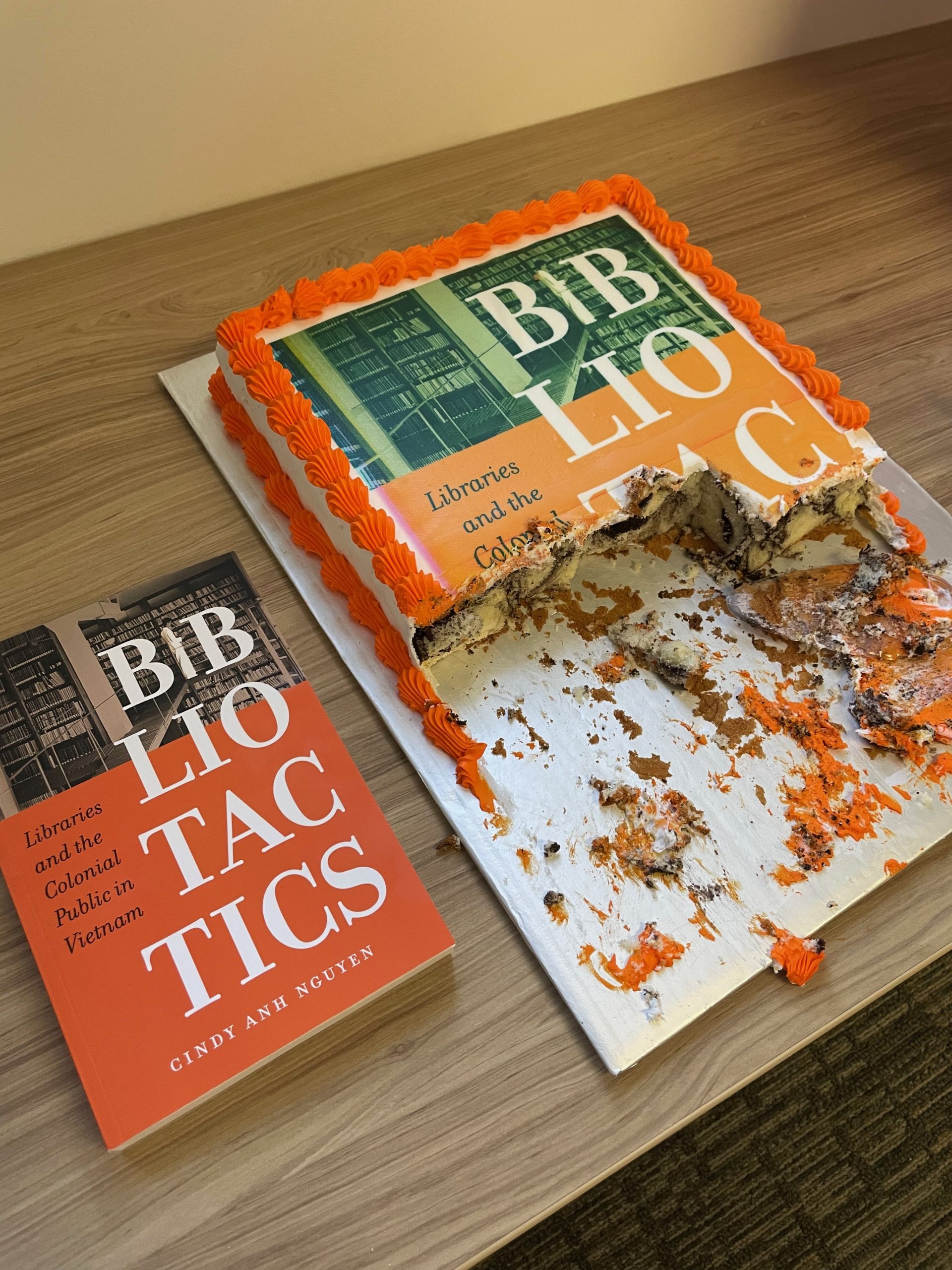
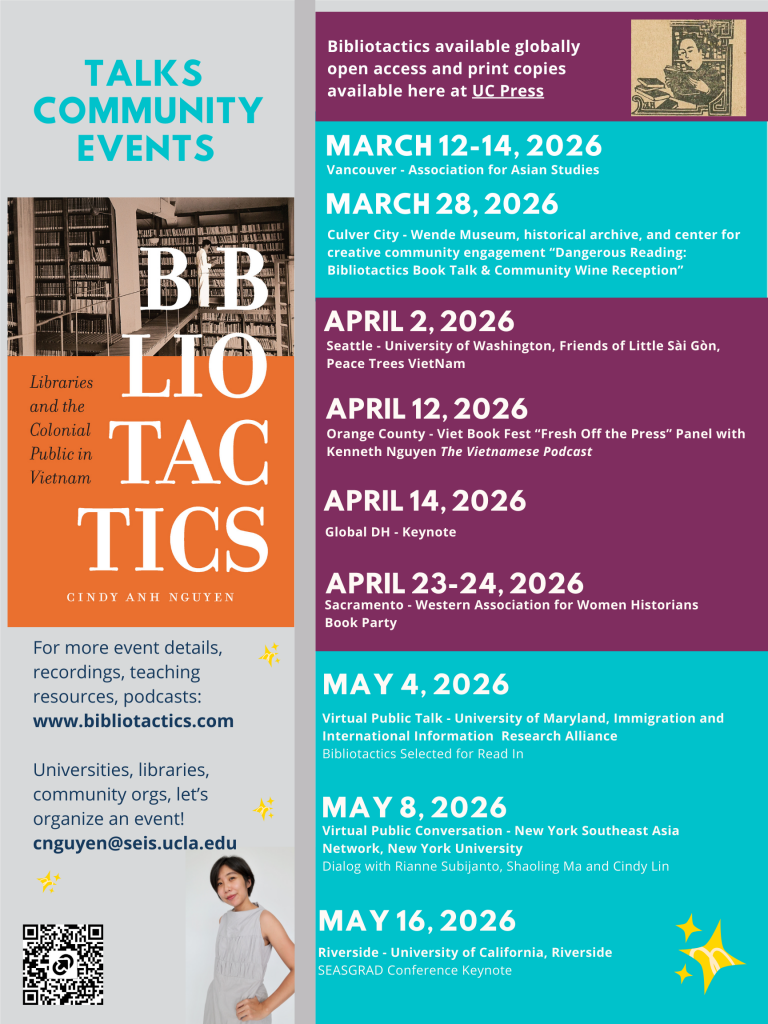
Below are a flurry of recap of the past month: Spring in person and virtual events, New Books Network Podcast, a book cake, oh my!
“Hoa Bằng depicted books as desirable food objects with attractive scents and providing spiritual nourishment. He noted how urban readers already had a certain “addiction” to this type of literary consumption and encouraged the spread of reading tastes more evenly throughout society to rural readers. ” p. 132 Bibliotactics
April 23-24: Western Association for Women Historians, Sacramento – Book Party
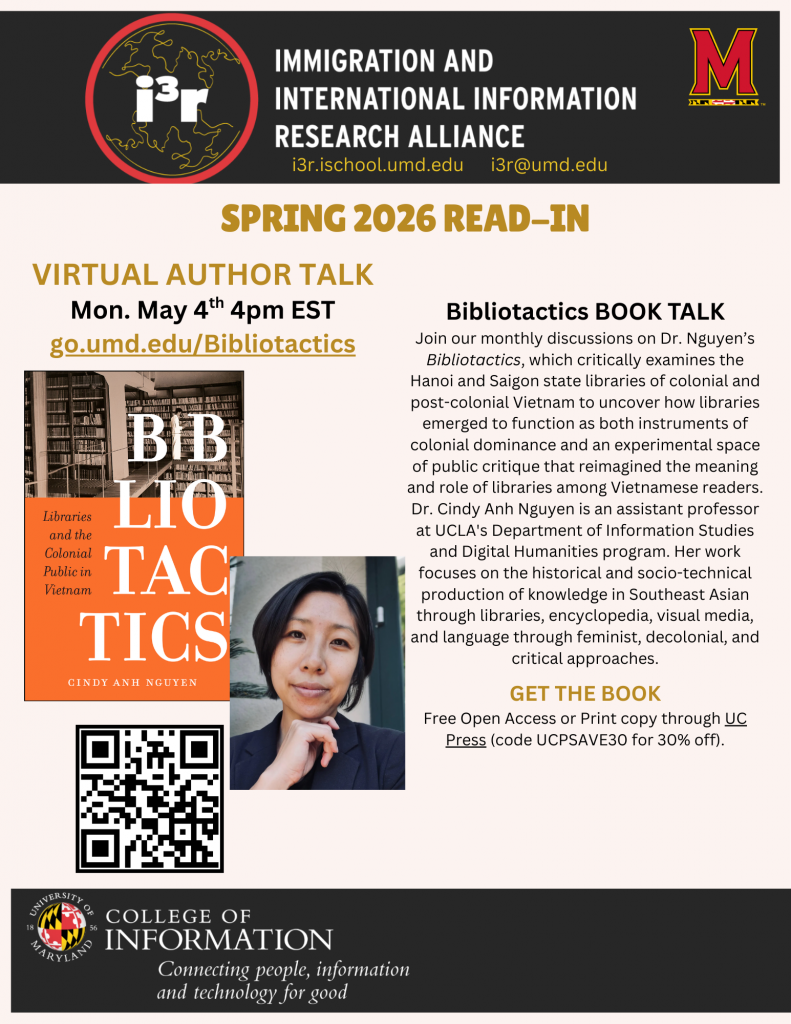
May 4: University of Maryland, Immigration and International Information Research Alliance, Bibliotactics selected for Read in – Virtual Author Talk, Zoom registration here
May 8: New York Southeast Asia Network, NYC – Virtual Conversation with Rianne Subijanto, Shaoling Ma, and Cindy Lin
May 16: SEASGRAD Conference Keynote, University of California, Riverside
Join us in Saigon for experimental community talks around reading, feminism, and art. It’s an honor and dream to “start” my book tour in Saigon (where the intellectual/personal/political journey began) alongside feminist cothinkers Minh and Yen.
Nguyễn Art Foundation is pleased to present a two-part event (8 & 9 August) that brings together scholars and practitioners exploring the complex entanglements between reading, gender, institutional power, and historical memory in Vietnam and its diasporas. Moving across colonial archives, library histories, and literature, the program rethinks the act of reading – not as passive consumption, but as a site of resistance, imagination, and world-making. Through diverse lenses – feminist critique, critical fabulation, and institutional analysis – these speakers interrogate who gets to read, what is considered public or private, and how gendered dynamics shape literary and cultural encounters. The program highlights how readers, particularly women, have long negotiated visibility, agency, and power through their engagement with texts.
Day 1 – 8 August: Library History as Data-Art-Life: Fabulating the Vietnamese Past with Dr. Cindy Anh Nguyen
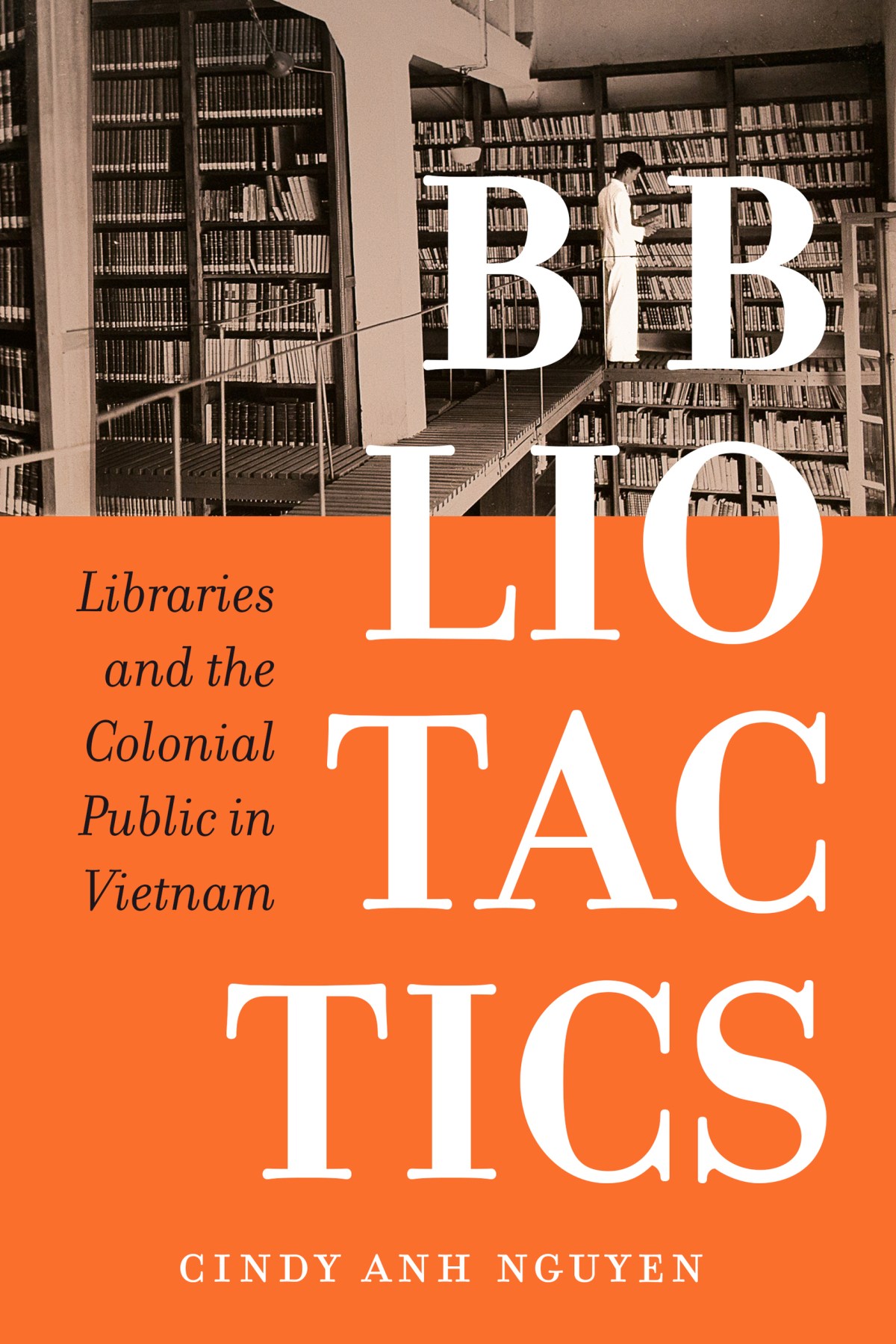
This talk is an invitation into the experimental transdisciplinary approach of Dr Nguyen’s book ‘Bibliotactics: Libraries and the Colonial Public in Vietnam’. Beyond an academic book of Vietnamese history, it is a work of critical fabulation through visual archives, data aesthetics, and experienced architectures. Interweaving method and theory, the author centers historical agency of Vietnamese library readers in colonial institutions, to ultimately trouble questions of power and publicity. This talk moves from static and disciplinary framings of History towards a dynamic crisscrossing of data-art-life that centers absence, imagination, and relationality.
Day 2 – 9 August: Women’s Reading: Theory and Practice with Dr. Cindy Anh Nguyen and Dr. Yen Vu. Moderated by Dr. Nguyen Thi Minh
1/ ‘Women Library Reading Publics and Redefining Publicity in Late Colonial Vietnam’ by Dr. Cindy Anh Nguyen
This presentation explores how late colonial Vietnamese women were central to redefining discursive and functional meanings of publicity. Through tracing the creation of “bình dân thư viện,” these communal and public library initiatives questioned the various political meanings of “bình dân,” the commoner, the people, or accessible to the general public. The author will show how “public” could mean access to a wide range of people, including women, provincial readers, and youth; social welfare for the commoner and disenfranchised; or collective national identity through shared vernacular language and literary heritage. As a public space for cultural exchange, self-erudition, and intellectual discourse in a shared language, Vietnamese public libraries functioned as bottom-up experiments in forming imagined communities of readers and public citizens.
2/ ‘Reading women against the grain: A feminist method among masculine voices’ by Dr. Yen Vu
Can our work still be feminist even if the materials we work on are masculine and exclusionary? How can we read the textual representation of women in a way that is not bound by their definition as characters represented by men? In this talk, Dr. Vu draws from her experience negotiating with gender representation her my own research on francophone writing, dominated by masculine voices. The author will present the case of Tran Van Tung’s francophone novel ‘Bach Yen ou la fille au coeur fidele’ (1946) to exemplify how we can still pose critical questions in line with a feminist epistemology despite the text’s masculinist predispositions. Beyond the gender dynamics of the nationalist cause, the author will also focus on the formal construction of the novel, and how text emerges beyond the intentions of the author.
Bio:
Cindy Anh Nguyen is Assistant Professor at the University of California, Los Angeles with appointments in Information Studies, Digital Humanities Program, and Asian Languages & Culture. Her forthcoming book ‘Bibliotactics: Libraries and the Colonial Public in Vietnam’ (University of California Press, 2026) uncovers how libraries functioned as both instruments of colonial dominance and an experimental space of public critique. Her work has appeared in Journal of Vietnamese Studies, Verge: Studies in Global Asia, Journal of Interactive Technology and Pedagogy, the Vietnamese American Refugee Experience Model Curriculum, Wasafiri, Ajar Press, Diacritics, and exhibitions such as ‘Textures of Remembrance: Vietnamese Artists and Writers Reflect on the Vietnamese Diaspora’.
Yen Vu teaches at Fulbright University Vietnam and is a scholar of 20th century Vietnamese literature. Her book project ‘Language as form, the politics and poetics of writing in French in 20th century Vietnam’ explores questions of language, freedom, and intellectual history. She received her PhD from Cornell University and subsequently held appointments in the French Department at Hamilton College and at the Weatherhead East Asia Institute at Columbia University. Her writing has appeared in Journal of Southeast Asian Studies, Diaspora, and Environmental Humanities. She also co-hosts a podcast called Nam Phong Dialogues that makes Vietnamese history accessible to the general public.
Nguyen Thi Minh is a tenured lecturer in the Faculty of Linguistics and Literature, Ho Chi Minh City University of Education. She was a visiting scholar at the University of Oregon (2018), a Fulbright scholar at the Asian American Studies Department, UCLA (2022–2023). In addition to translating multiple classical works in philosophy, gender, and cultural studies from English to Vietnamese, Minh works in comparative literature and film adaptation based on gender studies and semiotics, with her latest research publications featured in Hypatia: A Journal of Feminist Philosophy and Landscape Research in 2025. She is collaborating with the Vietnam Women Publishing House to build the Women’s Book: Gender and Development series to promote Vietnamese gender studies. Minh is the co-founder of The Ladder, an inclusive community learning space, which is making academic knowledge more accessible for everyone, especially the Vietnamese youth.
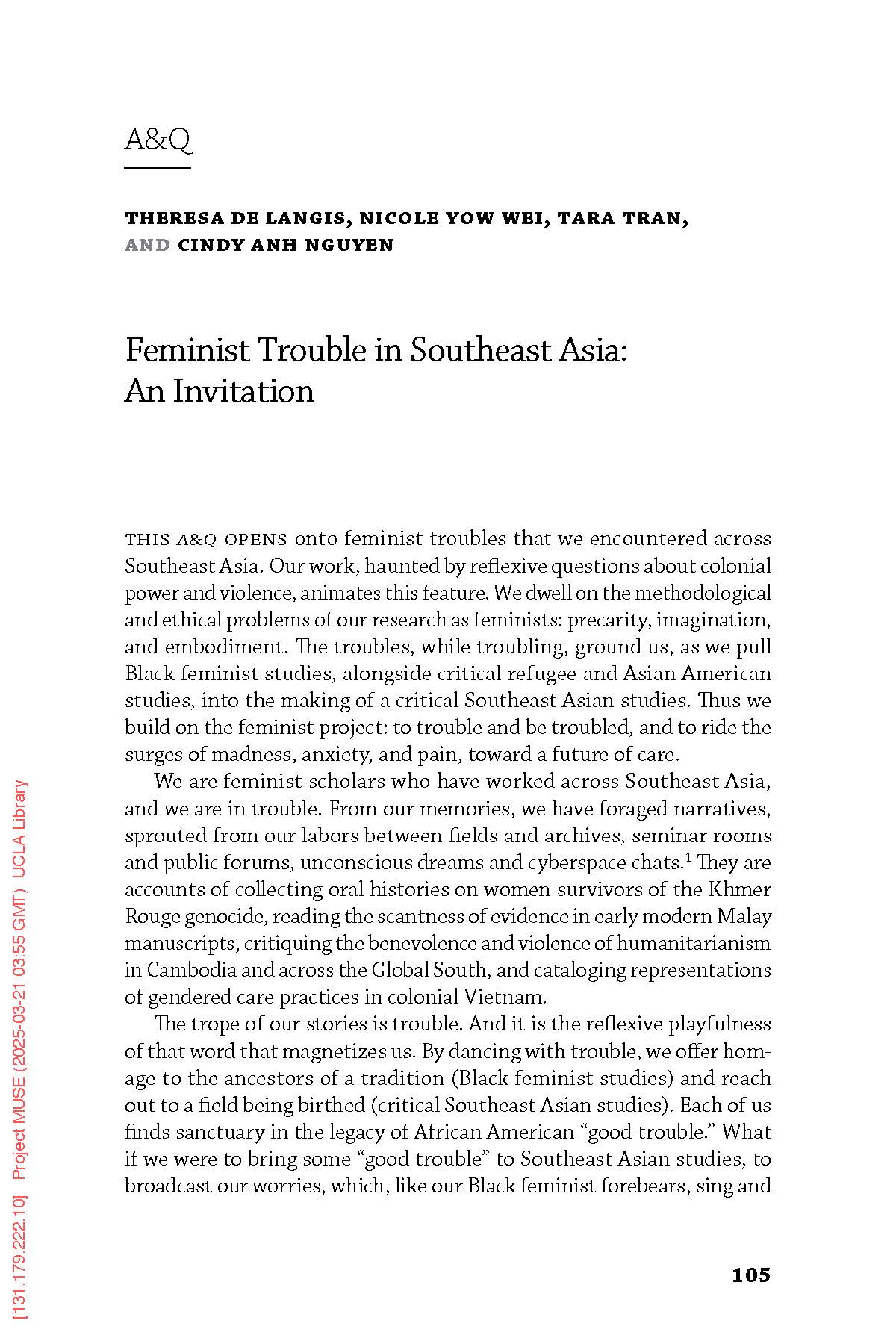
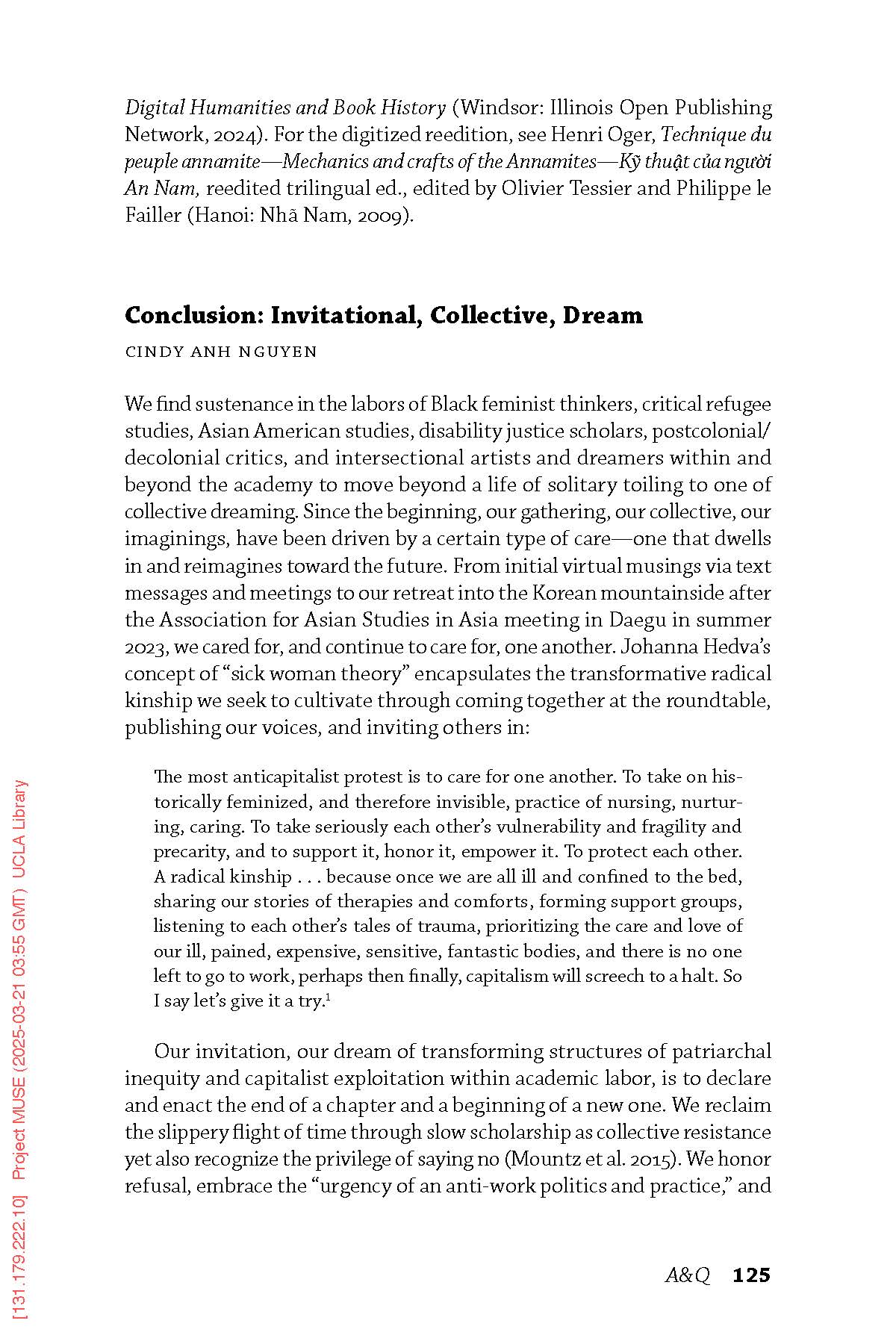
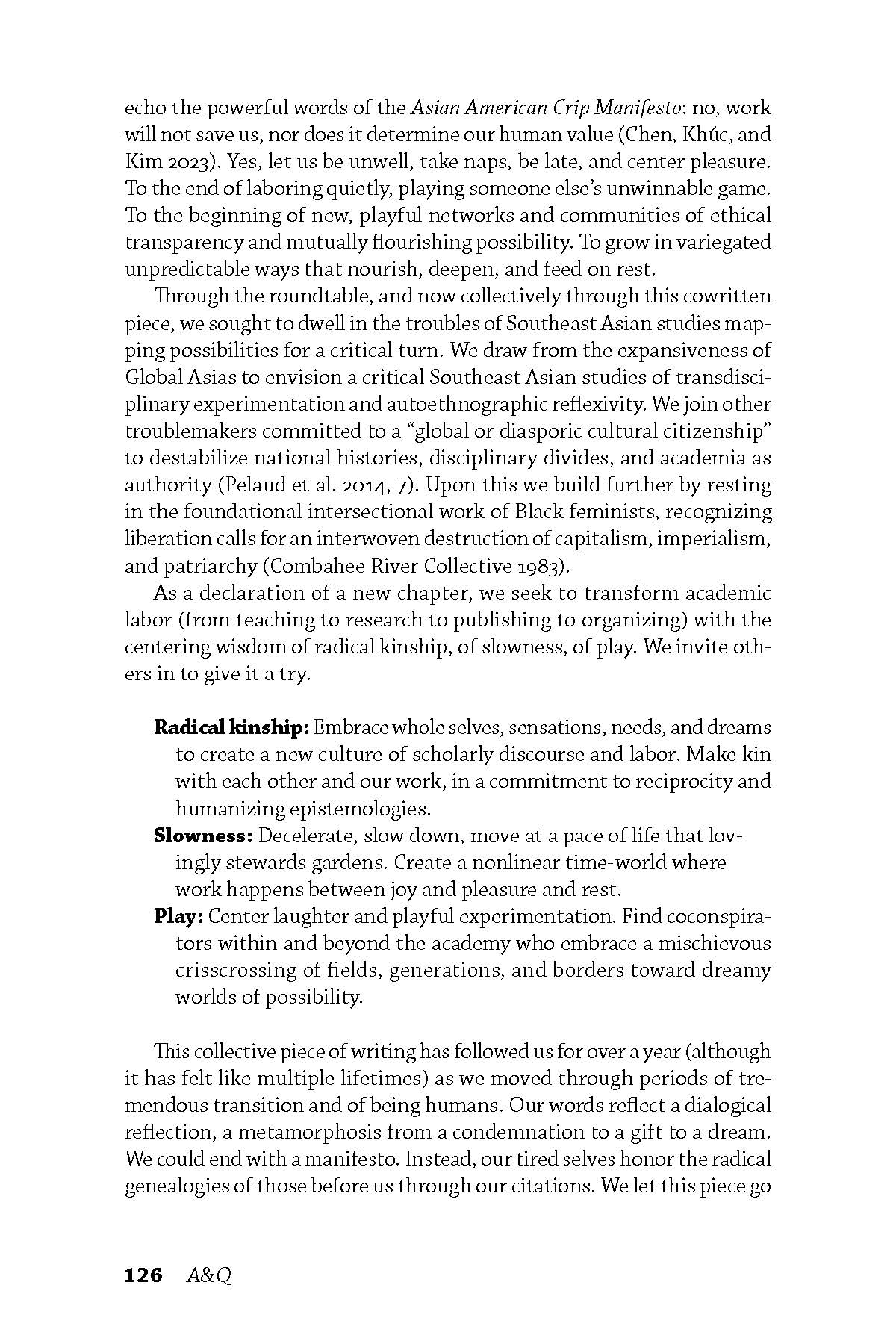
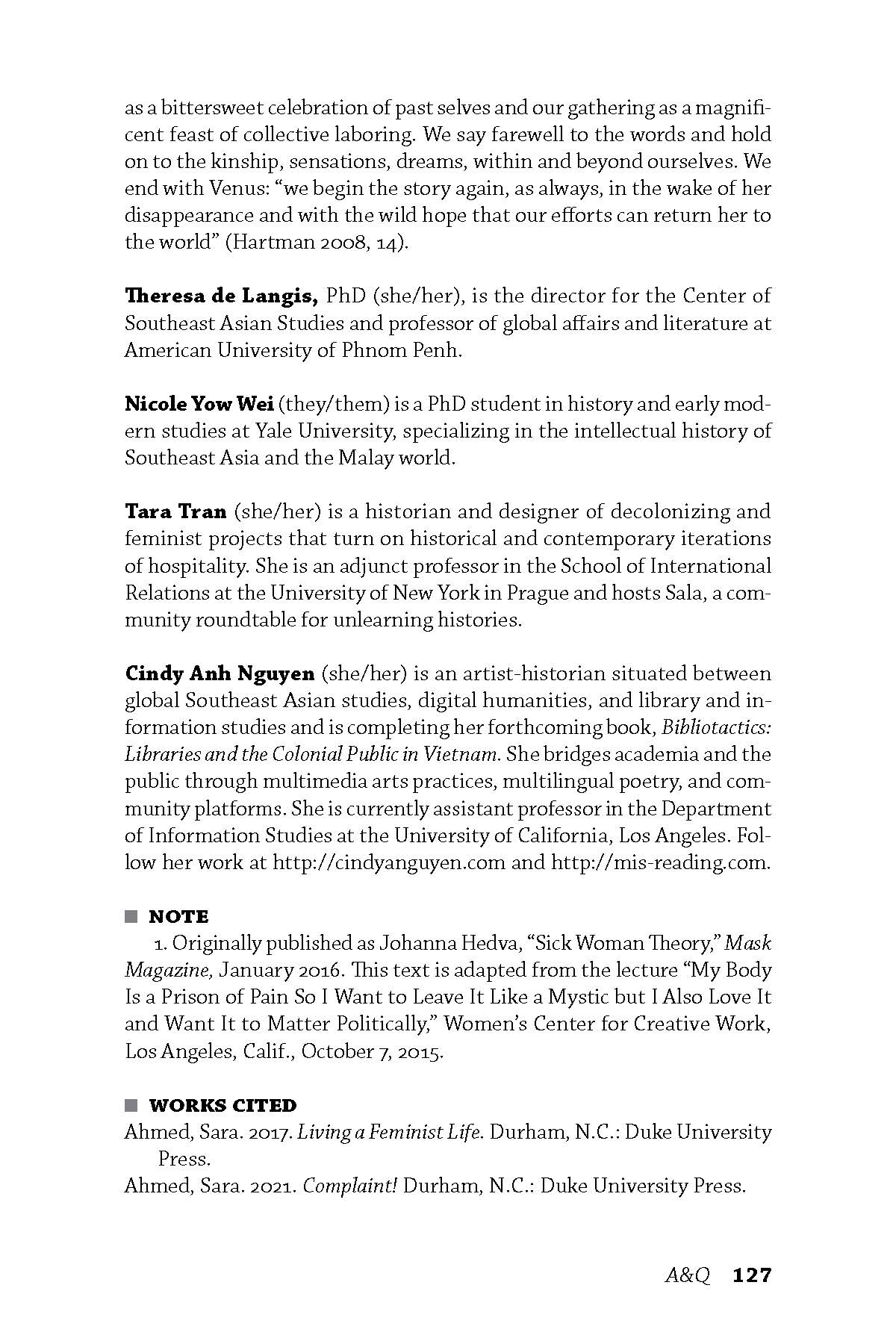
Truly honored to share the excerpts of our publication “Feminist Trouble in Southeast Asia: An Invitation”. It’s been a privilege to work together with fellow troublemakers Tara, Theresa, and Nicole, to redefine academic ‘work’ through relationships and centered on care. What appears like an academic article is more like an imprint of our collective gatherings, dreaming, and cowriting that spanned summer 2022 (submission to AAS in Asia roundtable- part community gathering part academic real talk) to the gathering in the mountains of South Korea in 2023, to finally its written linear format in spring 2025. As I alluded to in my “Collecting Through Absence” piece, this has been a long transitional period of turning towards a different type of scholarly identity and community artist, a feminist troubling of knowledge and narrative, that celebrates relationality, experimentation, and transdisciplinarity–a surrender into the world of “what if” rather than creating from a world of “what is”. This truly is an invitation, please do reach out to join us, dream/make with us. Follow along here: http://mis-reading.com/trouble/
For published article, see
Theresa de Langis, Nicole Yow Wei, Tara Tran, Cindy Anh Nguyen (2025) “Feminist Trouble in Southeast Asia: An Invitation”, Verge: Studies in Global Asias, 11:1, 105-130, DOI: https://doi.org/10.1353/vrg.2025.a951540
If you leave a comment with your email/ or email me at cnguyen@seis.ucla.edu, happy to send you the full article without paywall….(shadow library link to file)
Excerpts of Introduction, Conclusion and Citations
Excerpt from my subsection “Care As Knowledge, Care as Labor: Toward Relationally and Making Kin”
I make visible to readers my dreams in all their fragmented mess: to weavetogether the intellectual, personal, and collective threads in a reflexivetroubling tapestry that makes visible care as knowledge and labor. I beginwith my historical research on care, abruptly recognize the care work ofacademic labor, and close with an invitational collective dream of a futureinformed by feminist and decolonial kinship. I center Haraway’s (2016,1) reminder that future making is not of imagined safety or of clearingdangers of the past and present but is instead to “make kin in lines ofinventive connection as a practice of learning to live and die with eachother in a thick present. . . . Staying with the trouble requires learning tobe truly present, not as a vanishing pivot between awful or edenic pastsand apocalyptic or salvific futures, but as mortal critters entwined inmyriad unfinished configurations of places, times, matters, meanings.”
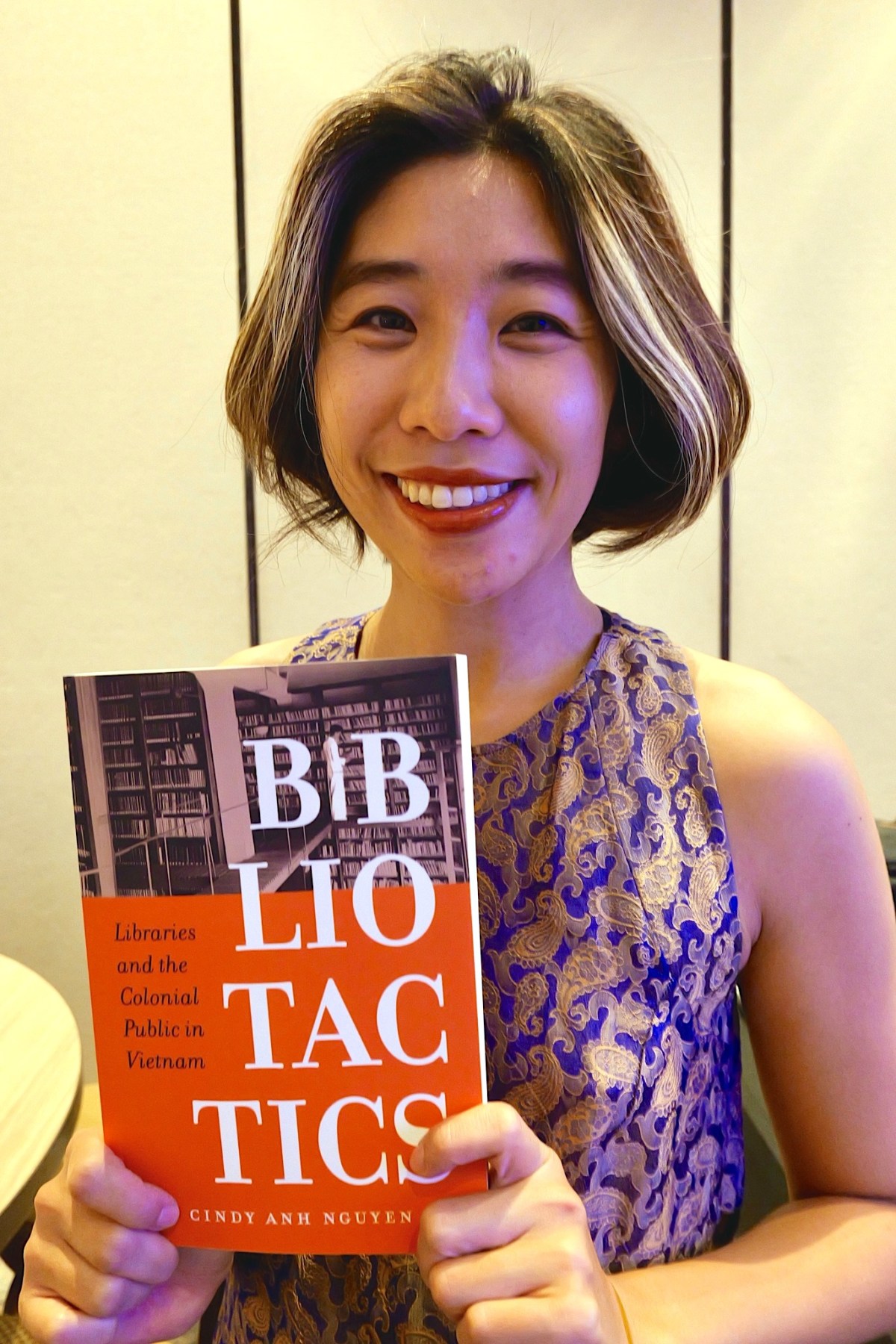
My forthcoming book Bibliotactics: Libraries and the Colonial Public in Vietnam is now available for preorder from UC Press with the promo code UCPSAVE30. Be the first to pick up your print copy to be published and shipped by January 13, 2026. Open access editions through Luminos will also be available that date worldwide. Online ordering of print copies through UC Press is available for US and Canada. Other locations can order by selecting Amazon, Barnes & Noble, or Bookshop. https://www.ucpress.edu/books/bibliotactics/paper
You can also follow along with talks, events, excerpts on my book website at http://bibliotactics.com ! If you’d like to schedule an upcoming book talk or event, please reach out to me at cnguyen@seis.ucla.edu
Excerpt: “This piece is part of a commitment to sharing and creating human communities of care alongside the materialist structures of support that constrain the everyday, such as time and resources. Interwoven with feminist and decolonial praxis, this piece includes a collection of critical pedagogy tactics, as well as syllabi excerpts from two digital humanities classes and an information studies class, and concludes with experimental dream classes for digital humanities. I also draw from my decade of teaching across disciplines and K–16 curricula and my commitments to critical pedagogy to reflect upon the specific experiences of teaching digital humanities courses this past academic year (2023–2024) that focused on historical data and visualization with a commitment to feminist and decolonial approaches. This past year, I taught a graduate introduction to digital humanities course with a focus on project management and public communication and a capstone undergraduate course focused on French colonial Vietnamese historical data. I also taught a graduate course on global libraries and decolonial futures primarily for graduate students completing their master’s degree in library and information science. I facilitated specific assignments and transparent reflexive modes of communication in a frenzied pursuit of an alternative to the current status quo, a current world marked by invisibilized labor and erasure of disabled whole selves, where students and instructors carry a hegemonic weight of capitalistic linear time defined by benchmarks, grades, progress, bureaucratic evaluations, and pursuit of transferable skills to serve an anonymized impossible market. Drawing wisdom from communities of laboring scholar activists and artists, I conclude with aspirational models for teaching and researching digital humanities that center the whole selves of students and instructors as part of the world and committed to decolonial futures.”
Backstory: This publication took decades to write, in part, because it was an embodiment of so many life stages–graduate school, job market, postpartum, covid, now on the tenure clock. In earlier stages, it was written here during a collective writing sprint session: https://cindyanguyen.com/2023/12/08/on-slowness/ This new version of the piece is also my grappling with teaching this first academic year at UCLA…a former version of myself wouldn’t have necessarily connected the dots that the first year as professor, the classroom space was so deeply consumed by discussions of academic labor, and the ‘vibe’ of our class was so deeply anti-capitalist, anti-institutional, and exhausted in every direction.
This summer I will spend resting and nourishing my relationships to a handful of kin. Most of my life will revolve around finishing my book manuscript and completing existing commitments with collaborators. I will tend to other gardens starting in September. I want to honor a slow pace of work and life. I wish you all some deep rest and joy.
Students: I do not know yet what fall enrollment for my courses will look like given space and capacity constraints. Come to class the first day where we will go over the syllabus, see how much space and capacity we all have. I wish I could admit everyone but I also want to build a sustainable classroom environment for mutual flourishing. I will add a link to the preclass survey and syllabus here, most likely alap (as late as possible) in September sometime.
Kin: You know who you are and how to find me or when to find me in that other non-linear time world where there are no deadlines and work happens in-between joy and pleasure and naps.
“Making kin seems to me the thing that we most need to be doing in a world that rips us apart from each other, in a world that has already more than seven and a half billion human beings with very unequal and unjust patterns of suffering and well-being. By kin I mean those who have an enduring mutual, obligatory, non-optional, you-can’t-just-cast-that-away-when-it-gets-inconvenient, enduring relatedness that carries consequences. I have a cousin, the cousin has me; I have a dog, a dog has me.”
In the past, I was frustrated by how slow my work moved. I was impatient that my critical inquiry, confusion, curiosity forced me to constantly revisit sources, translations, historical contexts. Market pressures to publish and produce (a talk, an article, a dissertation, a book, teaching, digital resources) with the promise of professional security perpetuated a structure of external validation of scholarly production.
As I begin this new position at UCLA and transition into my professorial role, I’ve been reflecting on my messy and vibrant intersections of intellectual, personal, and political commitments. My transdisciplinary work in Southeast Asian history, community arts, digital humanities, and collaborative multimodal learning are all unified by an approach of ‘world building.’ I examine worlds past through historical and digital humanistic inquiry. A world building approach recursively makes space for the interwoven work of critique-reimagination of worlds past, present, and future.
At the heart of worldbuilding is an intention to slowness.
I undertake a slow critical approach in world building to take time to wander, wonder, pause, and be deeply embedded in cultural social worlds. I strive towards an ethical responsibility to understand primary sources and data and their affordances of production. I work and walk alongside others in intentional collaborations of knowledge making, honoring overlapping and divergent motivations and interests. We journey in collective writing sprints, organize feminist gatherings of knowledge sharing, workshop rough ideas, and enact tactics of creating near future and distant future realities. Scholarship is a communication ecosystem–through classroom engagements, public talks, side conversations, I revise and revisit my thinking in a persistent commitment to learn and unlearn. All of this work, this quiet labor and recursive journeying is both painfully and pleasurably slow.
Slowness in Teaching (Part 1)
Teaching through pandemic and navigating infrastructures of labor exploitation has left me beyond exhausted. Intentional slowness in teaching is a tactic of self-preservation and invitation towards rest. I counter both internal and external pressures to continually ‘improve’ or ‘innovate’ my teaching with a set of slow tactics:
Each time I teach a course, I permit myself to only ‘innovate’ (change the structure of the course) in either content or form. That means, I only change the reading/topics or change the structure of assignments/modality.
I offer assignments that invite in slowness from students rather than structurally add more. For example, rather than another paper or project, I task students with a portfolio assignment that recompiles and reflects on previous work within the classroom.
Topics are substantively aligned vertically instead of pressures towards horizontal expansion. We take ‘one thing’ and create opportunities to dive deeper, offering space for comparative wonderings but recognize that expertise in all the things is impossible. A final project that hones into the ‘one thing’ allows students to slowly explore.
At the heart of slowness is creating a class culture and community. As instructor, I dedicate time to learn about students through:
Revisiting personal goals and experiences in the middle of term through a check in questionnaire. Example
Creating space to celebrate and commemorate the class journey through a shared activity such as collective ‘yearbook’. See extended discussion of yearbook celebration and other assignments in my Teaching Workshop
I joined the Virtual Angkor team late their dissemination stage as a teaching fellow, committed to rethinking how to ‘teaching’ with virtual heritage resources. I designed the following teaching module guided by the question “What does it mean to tour the past?” We carry this out firstly through a slow observation based learning (where often in university environments it’s all about fast, skimming, speed reading, losing the experiential wonderment of it all.) I organized this teaching module be a collective meditation on meaning making, guiding questions, vocalizing understanding, figuring out collectively an unfamiliar historic moment and social world of thirteenth century Angkor.
In this workshop, Dr. Nguyen invites participants to practice a ‘slow viewing, slow listening, slow thinking,’ process of meaning making in virtual reality that can be taught in classrooms focused on world history, global Asias, and digital media and design. Dr. Nguyen leads an exploration of Virtual Angkor, a virtual reconstruction of the medieval Cambodian capital of Angkor that seeks to explore the diversity and complexity of Southeast Asia in digital heritage studies. Virtual Angkor reappraises the neglected region of Southeast Asia as a dynamic and important center for understanding global processes of premodern urbanisms, climate change, and ‘non-western’ forms of governance and power. This workshop invites participants to enter a VR space to listen, examine, and question. The experience aims to facilitate a ‘critical making’ understanding of the past which undermines the romanticized representations of the exoticized orient or the ruins of Angkor that permeate both the French colonial record and the contemporary tourism industry complex of Cambodia.
Slowness in Research (Part 2)
My Decolonial Data Pedagogy Lecture with Fulbright-Hays (Middlesex Community College and Lowell Public Schools) Group (linked to above) has been a culmination of a slow alignment of my pedagogical and research commitments towards imagining a post/anti/decolonial approach to my research on colonial histories and knowledge production. Slowness was at the crux of this material-computational analysis of this peripheral text, Technique du Peuple Annamite,that haunted-mesmerized me since graduate school. After eight years of working on a different project (history of libraries) amongst other life things, I return to this work in full gusto. The slowness of ‘figuring out’ this text through close reading, material analysis, collaborative analysis, and computational modeling has given this work the timespan it needed to breathe and imagine. Digital humanities is not just method, but invited a commitment to decolonial data critique and to platform a decolonial imagining, a building of an alternative world beyond/in contestation with its colonial confines.
Slowness as Method
My regular check in: “Is this new idea/approach/methodology substantive or additive?”
As of late, I’ve been repeatedly told: “You have so much energy!” “You’re so productive!” and I often blink back in cognitive dissonance to the comments because they shroud the quiet, recursive labor of what it means to do teaching and scholarship on the everyday. Folks see the product, not the process.
I’m slowly trudging through a mess and I embrace it. Slowness is a feature not a bug (particularly in virtual reality and computational analysis). Slowness is an invitation to critique and contextualize. Slowness is a pedagogical imperative to permit students to be curious again, to reflect and to celebrate. Slowness is a license to pause, rest, and do nothing.
On Slowness, A Feminist Reader (in progress)
Agamben, Giorgio. 1978/1993. Infancy and History: The Destruction of Experience. London: Verso.
Ahmed, Sara. 2017. Living a Feminist Life Durham: Duke University Press. Ahmed, Sara. 2021. Complaint! Durham: Duke University Press.
Casarino, Cesare. 2008. Time matters: Marx, Negri, Agamben, and the corporeal. In Cesare. Casarino & Antonio Negri (eds), In Praise of the Common. Minneapolis: University of Minnesota Press, pp. 219-246.
Combahee River collective. “A Black Feminist Statement.” April 1977, Boston, Massachusetts.
Chen, Mel Y., Mimi Khúc, and Jima B. Kim. 2023. “Work Will Not Save Us: An Asian American Crip Manifesto.” Disability Studies Quarterly43, no. 1 (Fall).
Halberstam, Judith. 2011. The Queer Art of Failure. Durham: Duke University Press.
Haraway, Donna J. 2016. Staying with the Trouble: Making Kin in the Chthulucene. Durham, North Carolina: Duke University Press.
Hartman, Saidiya. 2008. “Venus, in Two Acts.” Small Axe 12, 2 (June 2008): 1-14.
Mountz, Alison, Anne Bonds, Becky Mansfield, Jenna Loyd, Jennifer Hyndman, Margaret Walton-Roberts, Ranu Basu, Risa Whitson, Roberta Hawkins, Trina Hamilton, Winifred Curran. 2015. “For Slow Scholarship: A Feminist Politics of Resistance through Collective Action in the Neoliberal University.” ACME: An International Journal for Critical Geographies 14, no. 4 (2015): 1244.
Tuck, Eve and Wayne Yang. “R-Words: Refusing Research.” Humanizing Research: Decolonizing the Qualitative Inquiry with Youth and Communities. Django Paris and Maisha T. Winn, eds. Los Angeles: Sage Publications, Inc., 2013: 223-248.
Truly honored to share the pre-print of my latest publication. This piece was produced in conversation with this ambitious special issue on the ‘littoral zone’ and the expansive ways in which we think/create/imagine Southeast Asian studies. Yet this piece also had several before lives, workshopped in literary arts communities and women’s writing groups that emboldened me to bring together my commitments to academia and arts in a singular embodied piece of writing. This piece marks my own transitional littoral moment, a turning of the chapter towards a different type of scholarly identity and community artist, a feminist troubling of knowledge and narrative.
For published essay, see
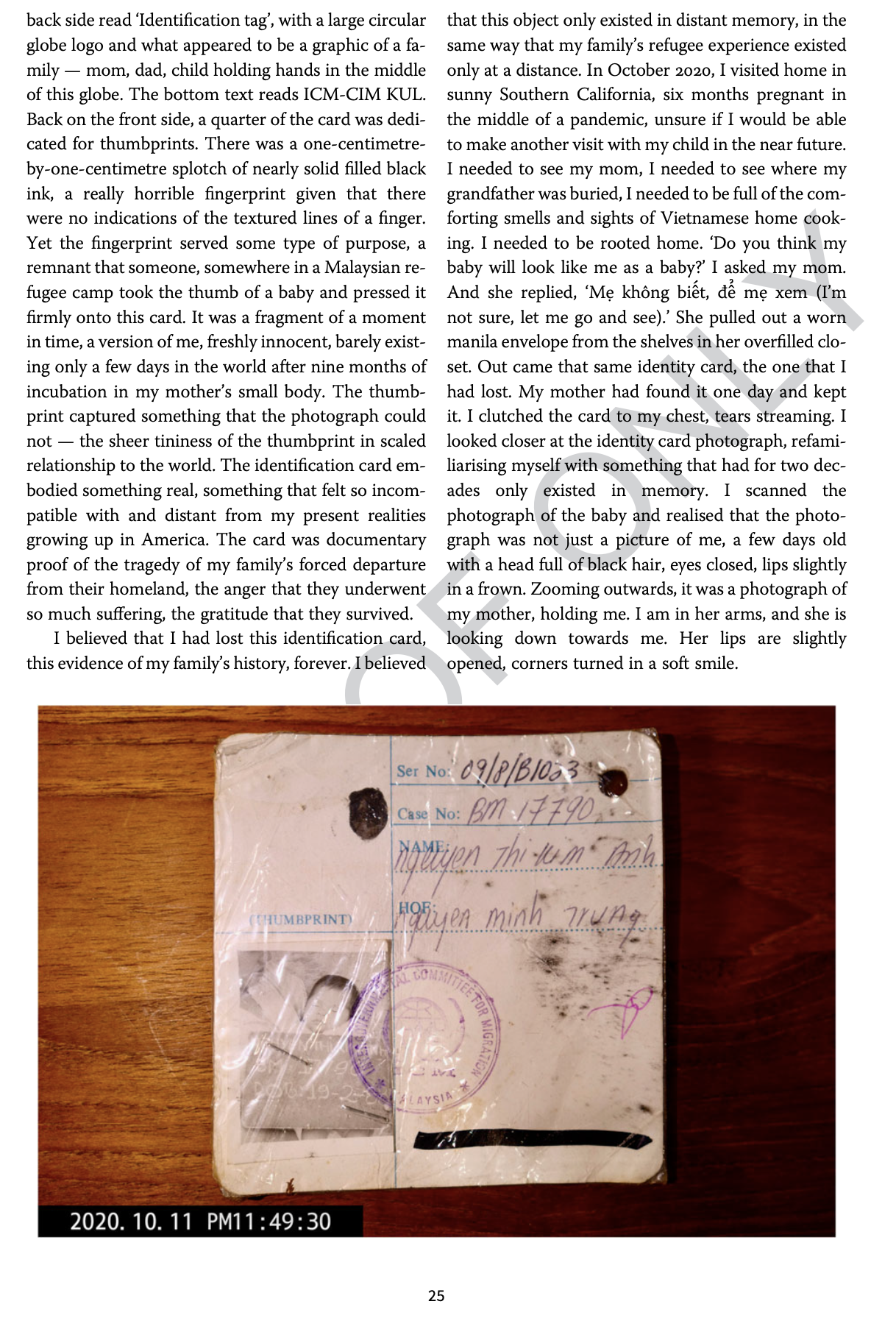
Cindy Anh Nguyen (2023) “Collecting Through Absence: Fragmenting Vietnamese Refugee Archives”, Wasafiri, 38:4, 22-30, DOI: 10.1080/02690055.2023.2237770
Excerpted from the opening essay by editors Nazry Bahrawi, Joanne Leow, and Y-Dang Troeung:
Etymologically derived from the Latin litus (shore), the word littoral refers to something that is ‘of or belonging to the seashore’. In oceanography and marine biology, ‘the littoral zone’ is the area of closest contact between the land and the water: the intertidal zone, the high-water mark, estuaries, straits, the continental shelf, and more. In the military, the littoral zone is associated with littoral warfare involving combat operations oscillating between water and ground. The littoral also invokes associations with edges, beaches, waterlines, litter, sediment, and drift. The littoral zone offers a rich metaphor for thinking through contact between material spaces such as the land and the sea, and conceptual spaces such as empire and ecology.
Surrounded by oceans, seas, and straits, with its multiple histories of maritime empires and nations, Southeast Asia lends itself particularly well to the study of the littoral zone, as source of livelihood for so many but also as subject of historical and contemporary colonial and postcolonial land reclamation and maritime disputes. From the colonial eras to the post-Cold War moment, Southeast Asian seas, straits, and estuaries have seen the transport of indentured workers, migrants, refugees, trafficked people, deportees, and many other racialised peoples whose bodies and labour have been rendered surplus.
In conversation with communities of artists and scholars in Southeast Asia, we have curated this special issue on Southeast Asia and the littoral. The littoral zones of Southeast Asia are contested spaces and in constant flux: the issue’s focus on postcolonial Southeast Asian texts (from Singapore, Cambodia, Malaysia, Indonesia, Philippines, Vietnam, and Myanmar) aligns with Wasafiri’s long-standing focus on the themes of empire, colonialism, and decoloniality. Thus, a combination of critical, creative, and artistic works is necessary to capture the elusive and mutable nature of these ecologies and landscapes. The selection of contributions – that range from creative writing, traditional scholarship, visual art, poetry, photography, interviews, reviews, and hybrid format works – provide place-based testimonies and glimpses into the complex experiences of existing on the shoreline.
In July 2023 I delivered a scholar talk to curriculum writers working on the “Vietnamese American Refugee Experience Model Curriculum” as part of broader state initiatives to incorporate Southeast Asian studies and refugee experiences as part of K-12 curriculum. It’s an honor and privilege to be part of this educational movement, and I provided through my lecture longer contextual histories of Vietnam to situate teaching and learning about diaspora, culture, and politics of Vietnamese American refugee experiences.Below is my lecture and links to primary sources, ideas for teaching materials, and I am excited to see the development of the curriculum and open source publication of teaching materials to come.
Part 1: History and Agency
Part 2: Culture and Power
Activity: Primary Sources
“Culture and Power: Colonial Vietnam and its Legacies“
This talk explores the historical context and legacies of French colonial Vietnam from 1858 to 1945. This talk will focus on colonial Vietnam and the interwoven themes of culture and power. Rather than position colonialism as an external agent of change, this talk analyzes the colonial encounter as complex exchanges, geographically diverse, and socially uneven. Key debates addressed include the production and legacies of colonial knowledge, the impact of global capitalism, construction of Vietnamese modernity and civilization, and articulations of identities around gender, class, and nation. To contextualize the historical context of French imperialism in Indochina (Vietnam, Cambodia, Laos), I position nineteenth and twentieth century Vietnamese history within the long autonomous histories and diverse region of Southeast Asia.
[Given the abridged length of the talk, I had to cut most of this discussion out: This talk covers two case studies to demonstrate the political economy and cultural impact of French colonialism and its legacies in Vietnam: colonial tourism and libraries. The first case study examines visual and textual representations (historic film, maps, tourist advertisements) of Indochina and the ways in which Vietnam was exoticized for Western tourist consumption. These historic tourist documents function as source critiques to understand the relationship between power and culture—how colonial documents exoticized and created caricatures of essentialized notions of Vietnameseness, how these types of representations continued on in the 1950s and 1960s during American intervention, and how exoticized representations of the ‘Vietnamese past’ influence contemporary Vietnamese tourist industries today. I also contextualize the rise of colonial tourism as part of infrastructural and social-economic transformations of twentieth century Vietnam— urbanization and transportation networks, ecological devastation, plantation economies and resource extraction.
The second case study examines the colonial building of the Hanoi library, and traces the social-cultural practices of public reading and use of public space by Vietnamese readers. I explain the history of language (multilingual writing scripts, vernacular spoken language, literacies), colonial education, and urban environments in Vietnam and showcase the legacies of colonial institutions in postcolonial Vietnam. These two case studies open up the discussion around the historical construction of ‘Vietnam’ as a unified cultural and political identity, transformed and fractured by a relatively recent twentieth century history of foreign intervention (colonialism, decolonization, militarism).]
My own personal, political, and pedagogical commitments to teaching cultural histories of colonial Vietnam are grounded in cultivating critical, anti-racist, global frameworks. I am commited to teaching students a complex understanding of colonialism and its legacies in Vietnam in order to learn decolonial frameworks and analytical tools 1) to recognize and critique systems of inequality (racism, exoticism, capitalist exploitation) and 2) to recenter narratives of agency and cultural production in Vietnam.
Secondary Sources
Cindy Nguyen, “Reading Rules: The Symbolic and Social Spaces of Reading in the Hanoi Central Library, 1919-1941,” Journal of Vietnamese Studies, (2020) Volume 15, No. 3: 1-35. https://doi.org/10.1525/vs.2020.15.3.1
Cindy Nguyen, “Creating the National Library in Saigon: Colonial Legacies, Fragmented Collections, and Reading Publics, 1946-1958,” in Building a Republican Nation in Postcolonial Vietnam, 1920-1963, Volume 1, edited by Nu-Anh Tran and Tuong Vu, (Honolulu: University of Hawaii Press, 2022)
Stéphanie Ponsavady, Cultural and Literary Representations of the Automobile in French Indochina: A Colonial Roadshow, Palgrave Macmillan, 2018
Hue-Tam Ho Tai, Radicalism and the Origins of the Vietnamese Revolution, Cambridge: Harvard University Press, 1992
Martina Thucnhi Nguyen, On Our Own Strength: The Self-Reliant Literary Group and Cosmopolitan Nationalism in Late Colonial Vietnam, Honolulu: University of Hawaii Press, 2020
Aline Demay, Tourism and Colonization in Indochina (1898-1939), Cambridge: Cambridge Scholars Publishing, 2014.
Cindy Nguyen, “‘A Xu/sou for the Students’: A Discourse Analysis of Vietnamese Student Migration to France in the Late Colonial Period”. In Transnational Migration and Asia: The Question of Return, edited by Michiel Baas, 135–56. Amsterdam University Press, 2015. http://www.jstor.org/stable/j.ctt1963142.11.
(0-52 seconds) Street scenes: What does ‘urban’ Hanoi look like? What types of transportation, people, and buildings do you see?
(54 seconds) Food: The title slide describes eating as ‘peculiar.’ “Where eats are eats—but peculiar.” Describe the scene of people eating. What makes the eating ‘peculiar?’ What type of value judgment does the film make?
(1:29) Paper Industry: “Hanoi is a centre for an ages-old industry of paper-making—using special kinds of barks, pounded primitively into pulp.” What types of technologies and methods do people use to make paper? Who is involved in the papermaking process? Why does the film describe this as ‘primitive?’
(2:44) Writing: Who is writing? What type of writing system is the ‘public writer’ using?
Who might the audience be for this compilation of documentary footage of Hanoi? What makes you say that?
Creative remixing of historic comics from 1930s Vietnamese periodical, by Sonya Bui
“How to Behave in Vietnam”, Speech by Tran Long, 1960, cultural differences between east and west, historical context of Vientamese-American social relations during Vietnam War, cultural essentialisms and cultural translation http://vietnamproject.archives.msu.edu/fullrecord.php?kid=6-20-277
Additional Primary sources for teaching ‘legacies of colonialism: division’

![Feminist Trouble in Southeast Asia: An Invitation by Theresa de Langis, Nicole Yow Wei, Tara Tran, Cindy Anh Nguyen [New Publication]](https://cindyanguyen.com/wp-content/uploads/2025/07/p1585441-scaled.jpg-2.webp?w=1200)









 Cindy A. Nguyen